
What Your Nails Can Reveal About Your Health and Vitality
I had a lovely older fellow come to have a consult with me, and part of that consult involved me looking at his fingernails. Just doing that, sparked some really interesting questions. Starting with why was I interested in checking his nails in the first place? He said no-one had ever looked at his nails. I was thinking what a shame, because us homeopaths (sometimes) find such invaluable information which then plays a part (again, sometimes) in deciding on a well-chosen homeopathic remedy.
My first answer went like this: “Your nails might give some great clues about circulation, nutrition, how your metabolism is going, and how easy is it for you to repair and regenerate”.
His next question went like this: “What are you actually looking for?” My answer: “I’m looking at how they feel, their texture, their colour, and how strong they are, because this might reflect things going on a bit deeper within your body”.
Then this one: “So if I’m 75-years-old does it matter if my nails are shot, because I’m sure my friends all have nails that are a bit crook. I worked with my hands [as a carpenter] all my life.” Mmmmm. So then I decided I had better write this blog especially for him to fully answer that comment/question of his about does it matter?
And apologies right now to anyone who is 75 and doesn’t like the term “older age.” It’s fair enough, the trouble is that I still can’t figure out a better way to say it.
Nail Growth Throughout Life and Older Age
Research has shown that nail growth is fastest during early adulthood. From the late twenties onwards, growth gradually slows, with some studies suggesting a decline of approximately 0.5% per year. By the age of 100, nail growth may be around half the rate seen in younger adults. Because nail growth reflects circulation, metabolism, hormone balance, and nutrient status, it can provide useful clues into overall health.
Nail growth rates change throughout life and can also fluctuate in response to health problems.
Environmental factors also influence nail growth. Warm hands and feet generally mean healthy circulation, while colder temperatures can significantly reduce nail growth rates. If you frequently experience cold hands and feet, your body may be delivering fewer nutrients and less oxygen to the tissues responsible for nail regeneration. However, it is fairly common for an otherwise healthy person in their 60s, 70s, or 80s to say: “My feet are always cold these days.” If the feet warm up with socks, movement, or a warmer environment and there is no pain or discolouration, this is often simply an age-related change (as much as I hate to say that).
Several health conditions can affect nail growth as well including diabetes, cardiovascular disease, poor circulation, and thyroid disorders. Pregnancy often accelerates nail growth due to increased circulation and metabolic activity, while an under-active thyroid can contribute to slow-growing, brittle nails.
The Importance of the Lunula
The lunula is the pale crescent-moon-shaped area visible at the base of some nails, especially the thumbs. As people age, the lunula often becomes less visible. This may reflect a reduction in activity within the nail matrix, the area responsible for producing new nail cells. Yes, it is only one piece of the overall picture, but changes in the lunula may provide another clue regarding general health.
A fading lunula can sometimes mean there is:
- slower cell turnover, and slowing metabolic activity
- poor circulation,
- nutritional deficiencies.
In the photo below, it is good to point out that the eponychium is the living skin at the base of the nail, commonly referred to as part of the cuticle area. It helps protect the nail matrix where new nail cells are formed.
A useful distinction is that manicures often trim the cuticle, but the eponychium itself should not be cut because it is living protective tissue.
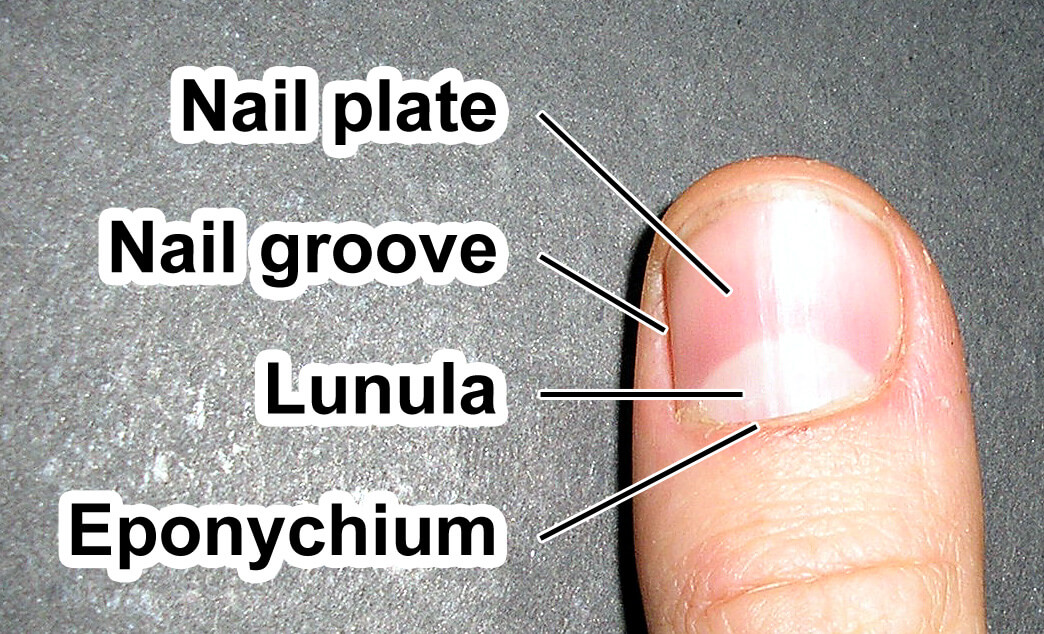
Lunula and areas of the fingernail. Source Wikipedia
Common Nail Changes Seen With Age
Ageing nails undergo several structural changes. Repeated wetting and drying, environmental exposure, reduced natural oil production, nutritional shortcomings, and wear and tear from manual work/trades that result in knocks and minor trauma can all contribute:
- Increased Brittleness – Many older adults develop nails that split, peel, or break more easily.
- Longitudinal Ridges – Vertical ridges running from the cuticle to the tip of the nail become increasingly common with age. These ridges may reflect slower cell renewal, reduced circulation, or nutritional imbalances caused by food sensitivities and poor digestion.
- Thickened Nails – Toenails in particular may become thicker over time. Reduced circulation, pressure from footwear, and slower turnover of nail tissue can contribute to this change.
- Pale nail colour may be from iron or protein deficiencies, or could show liver problems.
- Duller Appearance – Nails lose their natural shine and develop a pale or opaque appearance. This might be from changes in blood supply and nutrients getting to the nail bed.
- Terry’s nails – The fingernail looks white except for a narrow red or pink band at the top and the lunula is absent. They can be age related but also may be a sign of underlying health problems especially if it is new.
Nutrition for Strong Nails
Nails are primarily composed of keratin, a structural protein that depends on a range of nutrients for its formation and maintenance.
Protein
Protein intake provides the amino acids needed to build keratin and collagen. Poor protein intake may contribute to weak, fragile nails and slower growth. Being vegetarian doesn’t automatically mean there is lower protein intake.
Sources include eggs, fish, lean meats, dairy products, tofu, legumes, edamame, quinoa, nuts, and seeds.
Collagen
Collagen helps support the connective tissues surrounding the nail bed and contributes to overall nail strength. Bone broth and collagen-rich foods can provide valuable building blocks for healthy nail growth.
Vitamin C
Vitamin C is one of the most important nutrients for healthy nails (and it is often overlooked). It acts as an essential cofactor for collagen production, helping the body look after connective tissues that support healthy nail growth. Vitamin C is an antioxidant, helping protect nail-forming cells from oxidative stress and environmental damage. In addition, it enhances iron absorption, which is needed for nail growth and oxygen delivery. Rich dietary sources include citrus fruits, kiwifruit, berries, capsicum, and broccoli.
Vitamin D
Vitamin D contributes to healthy immune function, mineral balance, and tissue health, including the health of the nails. It supports normal cell growth, helps regulate calcium metabolism, and plays a role in maintaining healthy skin and connective tissues. Because vitamin D insufficiency is relatively common in older adults, vitamin D levels are frequently assessed by doctors when there are risk factors or concerns about bone health, falls, fractures, or limited sun exposure.
Biotin (Vitamin B7)
Biotin is involved in keratin biosynthesis and has been widely studied for its potential to improve brittle nails.
Food sources: Eggs, liver, nuts, and seeds.
Iron
Iron supports oxygen transport throughout the body. Low iron levels may contribute to weak, brittle, slow-growing nails.
Foods sources: dark green leafy vegetables, red meat, liver, lentils, spinach, and pumpkin seeds.
Zinc
Zinc supports tissue repair and cell division. Insufficient zinc intake may contribute to white spots, slow growth, and weakened nails.
Foods sources: Oysters, red meat, poultry, dairy products, eggs, beans, lentils, nuts, and seeds such as pumpkin seeds.
Magnesium
Magnesium is involved in hundreds of enzyme reactions throughout the body, including protein synthesis and tissue repair. A substantial proportion of older adults consume less magnesium than recommended, making magnesium insufficiency relatively common in later life. While magnesium deficiency does not typically produce a distinctive nail abnormality, inadequate magnesium intake may contribute to brittle or weak nails.
Food sources: Green leafy vegetables, seaweed, nuts, seeds, legumes, and whole grains.
Silica
Silica is a vital trace mineral that supports collagen production and strengthens connective tissues, helping prevent brittle nails and vertical ridges.
Food sources: Parsley, celery, cucumbers (especially the skin) and root vegetables.
Tissue Salts Traditionally Used for Nail Health
Tissue salts, also known as cell salts or biochemic salts, are mineral compounds used by homeopaths to help restore mineral balance in the body’s cells and tissues. Several tissue salts have been used traditionally to support healthy nail formation and growth.
Combination 12 Tissue Salts (which include all of the tissue salts listed below as well as others) are available as dissolvable tablets that can be sucked or allowed to dissolve in the mouth, making them an option for some older adults, especially those with reduced chewing ability, or swallowing difficulties.
Calcarea Fluorica
Often selected for brittle nails that crack, split, or become excessively hard and thickened. It is traditionally associated with maintaining elasticity in connective tissues.
Silicea
Commonly used for weak, fragile nails that break easily or grow slowly. Silicea has a long history of use in supporting healthy skin, hair, and nails.
Calcarea Phosphorica
Traditionally considered when nail growth appears slow. It is associated with growth, nourishment, and regeneration.
Ferrum Phosphoricum
Traditionally linked with circulation and oxygen delivery and may be useful where poor peripheral circulation accompanies nail changes.
Kali Sulphuricum
May be considered when there are recurring skin and nail issues involving peeling or scaling.
These tissue salts are readily available over the counter and are often used as supportive measures alongside a nutritious diet and healthy lifestyle.
Homeopathy and Nail Health
From a homeopathic perspective, nail changes including brittle nails, ridging, thickening, fungal infections, slow growth, and nail separation, can reflect underlying constitutional imbalances.
The most beneficial way to find an appropriate homeopathic remedy is through a consultation with a qualified homeopathic practitioner, and their individualised prescribing will take into account the person’s physical, emotional, and constitutional picture.
Some remedies considered in cases involving nail complaints include:
- Silicea for weak, brittle, distorted, or slow-growing nails.
- Graphites for thickened, cracked, or deformed nails, especially where skin problems are also present.
- Thuja occidentalis for fungal nail conditions, thickened nails, and distorted nail growth.
- Antimonium crudum for hard, thick, brittle nails accompanied by thickened skin.
- Calcarea carbonica for slow-growing nails and a tendency towards chronic fungal conditions.
- Tuberculinum bovinum when nail problems form part of a broader constitutional picture found through individualised assessment.
Published Homeopathic Case Reports Involving Nail Conditions
There are published case reports documenting positive outcomes using individualised homeopathic treatment for chronic nail disorders.
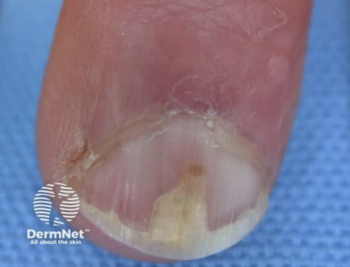
Onycholysis: source of the image is dermetnz.org
Onycholysis (nail separation)
A case report published in Homœopathic Links in 2021 described a 45-year-old woman with complete loss of the nail plate on the middle finger of her left hand due to onycholysis, a condition involving separation of the nail plate from the underlying nail bed.
Following detailed assessment, the homeopathic remedy Tuberculinum bovinum was prescribed and the patient was monitored over four months. (Photograph shown is from dermetnz.org to illustrate what onycholysis looks like.)
Photographs in the actual article documented gradual regrowth of the nail plate during treatment. The patient’s Dermatology Life Quality Index improved from 20 to 1, while assessment using the Modified Naranjo Criteria for Homeopathy produced a score of +8, suggesting a strong likelihood that the improvement was associated with the homeopathic intervention. The patient reported feeling “back to normal” in both her nail condition and overall wellbeing.
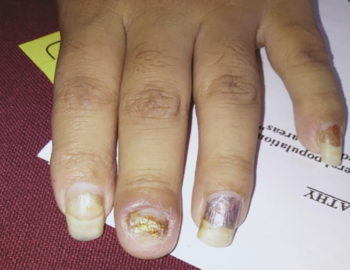
Subungual Onychomycosis from beginning of homeopathic treatment 2025
Subungual Onychomycosis (fungal infection)
Another published case report in 2025, described a 23-year-old woman diagnosed with subungual onychomycosis, a fungal nail infection responsible for a large proportion of nail disorders worldwide. Common symptoms include nail discolouration, thickening, onycholysis, debris beneath the nail, and distorted nail growth.
Following an individualised homeopathic assessment, Thuja occidentalis 200c was prescribed. During follow-up, swelling of the nail bed reduced and healthy nail regrowth was observed. The patient’s Dermatology Life Quality Index improved from 16 at baseline to 0 by the fifth follow-up visit. A final Modified Naranjo Criteria score of +8 suggested a high probability that the observed improvement was associated with the homeopathic treatment provided.
The authors concluded that individualised homeopathic treatment appeared helpful in managing the condition within a plausible timeframe.
Supporting Healthy Nails Naturally
- At the very least get some tissue salts to support nail health.
- If the following at-home measures don’t seem to be helping please seek out a professional homeopathic consultation.
- Keep hands and feet warm to support healthy circulation.
- Stay physically active through walking, stretching, gardening, or exercise.
- Protect nails from excessive water exposure by wearing gloves during household jobs.
- Apply jojoba oil to support hydration and flexibility.
- Avoid smoking, which reduces circulation to the nail beds.
- Get enough protein! Eat a nutrient-dense diet with healthy fats.
- Nail polish isn’t inherently bad when used in moderation. But, be aware of chemicals and what you use to remove the polish. The polish itself, harsh removers, and aggressive scraping often lead to wrecked nails, and white spots.
- Seek professional assessment when nail changes are accompanied by fatigue, temperature sensitivity, hormonal symptoms, or persistent health concerns.
Healthy Nails Come From the Inside Out
So back to my 75-year-old patient. After his first consult he went home with a carefully chosen homeopathic remedy, tissue salts and supplements of vitamin C and vitamin D. And in regard to his questions, I could easily have just said something like “Healthy nails come from the inside out. Your circulation and what you eat are important” … and I thought this blog is probably much more than what he really wanted…. But when I emailed him to say I had finished the blog he was so interested, and said he had become a convert and was talking to his friends about it now. There you go. That’s my good-news story for the week.

Many thanks to my patient for being the impetus to write this up.
We all need to talk more about nail health and aging.